Macalester · Summer 2026

MACRO
Summer Program

Multimessenger stellar astronomy with optical + VLA radio data. Six weeks of real datasets, real tools, and a defensible scientific result.

June 8 – July 14, 2026Mon–Fri · 10 AM – 12 PMIntro friendlyReal datasetsPaper-track goal
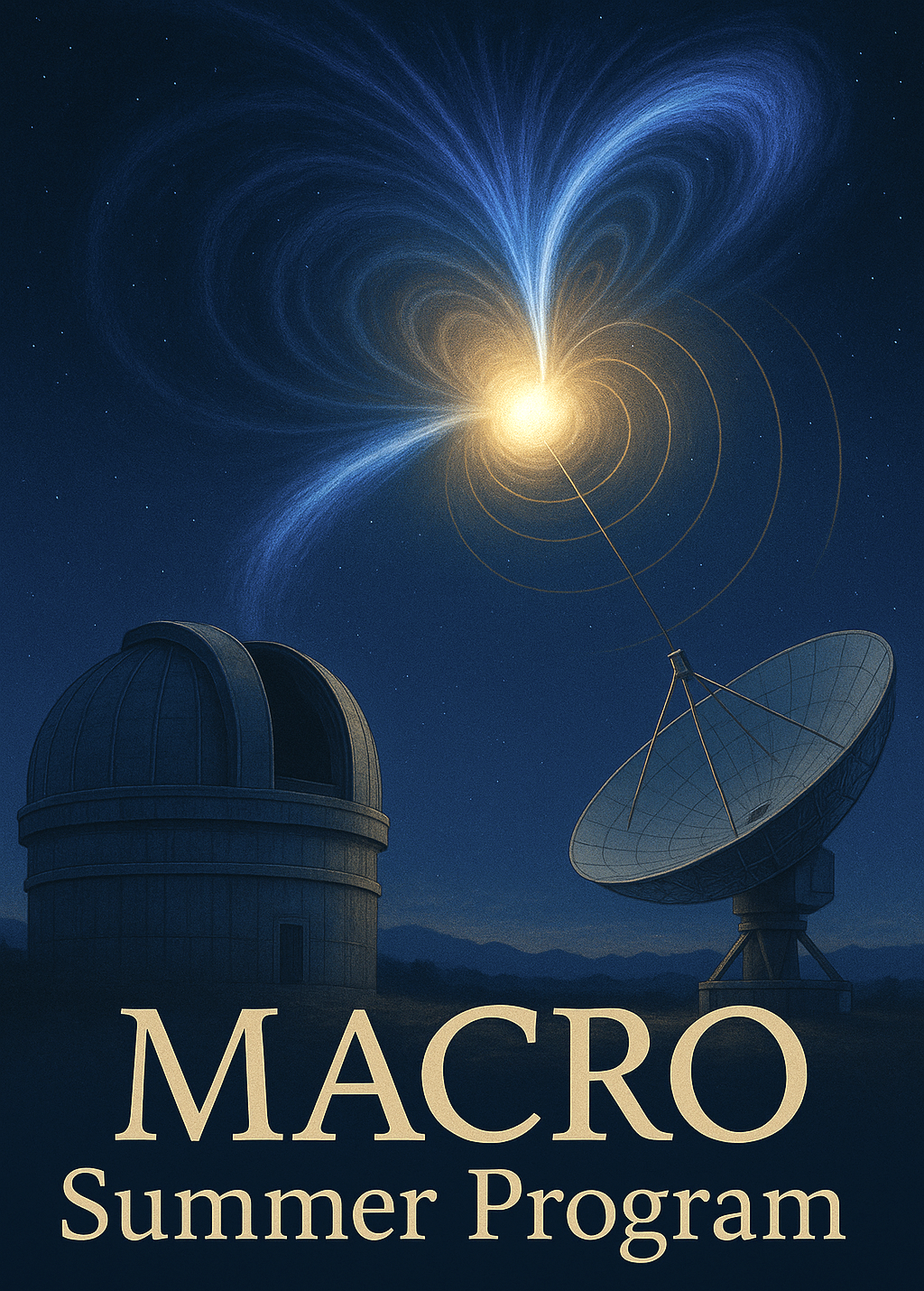
MACRO Summer Program — observatory dome and radio dish under a stellar outflow

The point

Students learn how to turn real optical and radio data into a defensible scientific result.

The arc

Weeks 1–3: learn on known datasets. Weeks 4–6: investigate a new dataset.

The output

Best case: paper contribution. Baseline: MACRO internal technical note + reproducible notebooks.

Daily rhythm

10–11

Concept

Short lecture. What are we trying to measure and why?

11–12

Guided work

Do the analysis together in Jupyter / DS9 / CARTA.

Next AM

Independent exercise

Submit a notebook, figure, table, or short writeup.

Tools

JupyterLab: NOIRLab or SciServer
Python: Astropy, Photutils, Astroquery, Matplotlib
DS9: FITS image inspection
CARTA / CASA: radio images and VLA data
GitHub: version control and notebooks
Targets: Be stars + MCV stars
Week 1 · June 8–12

Start from zero: “What is a FITS file?”

DateConceptHands-onDue / Output
Mon Jun 8What is astronomical data?Open FITS files; inspect headers; make first images.Data inventory notebook.
Tue Jun 9Python refresherArrays, plots, functions, tables.Clean Python warm-up notebook.
Wed Jun 10Coordinates and WCSPixel ↔ sky coordinates; mark sources.Find 5 sources and report positions.
Thu Jun 11Images have noiseBackground, RMS, saturation, artifacts.Image quality notes + basic statistics.
Fri Jun 12Reproducible workflowNotebook template + GitHub basics.Week 1 deliverable: open, inspect, plot, and describe a dataset.
Week 2 · June 15–19

Measure stars

DateConceptHands-onDue / Output
Mon Jun 15Aperture photometryMeasure source flux and background.Photometry for 3–5 stars.
Tue Jun 16UncertaintyError bars, S/N, bad measurements.Photometry table with uncertainties.
Wed Jun 17CalibrationComparison stars; differential photometry.Simple light curve.
Thu Jun 18CatalogsGaia/Simbad/VizieR-style crossmatching.Crossmatched source list.
Fri Jun 19Be stars / MCV starsWhat makes these targets interesting?Week 2 deliverable: measured optical sources with errors.
Week 3 · June 22–26

Add radio data

DateConceptHands-onDue / Output
Mon Jun 22Radio imagesBeam, Jy/beam, contours, RMS.Radio image summary.
Tue Jun 23Radio fluxPeak flux, integrated flux, upper limits.Radio measurement table.
Wed Jun 24Optical + radio togetherOverlay contours on optical images.One multiwavelength figure.
Thu Jun 25Known resultReproduce a known MACRO-style measurement.Known-result notebook.
Fri Jun 26From measurement to claimDiscuss systematics and interpretation.Week 3 deliverable: short known-dataset report.
Week 4 · June 29–July 3

New dataset: first look

DateConceptHands-onDue / Output
Mon Jun 29Introduce new targetWhat data do we have?Dataset inventory.
Tue Jun 30Quality controlFind usable / questionable data.QC memo.
Wed Jul 1Source findingIdentify targets, counterparts, offsets.Source list v1.
Thu Jul 2First measurementsOptical fluxes, radio fluxes, upper limits.Measurement table v1.
Fri Jul 3Pick questionsWhat can this dataset actually answer?Week 4 deliverable: dataset memo + possible science questions.
Week 5 · July 6–10

New dataset: focused analysis

DateConceptHands-onDue / Output
Mon Jul 6Choose subprojectsEach student/pair owns one question.Analysis plan.
Tue Jul 7Build the pipelineClean notebooks; repeatable measurements.Measurement table v2.
Wed Jul 8SystematicsAperture choices, background choices, radio RMS.Systematics test.
Thu Jul 9FiguresMake clean science figures.Draft figure captions.
Fri Jul 10Peer reviewGroup critique of notebooks and claims.Week 5 deliverable: analysis notebook + draft figures.
Week 6 · July 13–14

Finish and present

DateConceptHands-onDue / Output
Mon Jul 13Turn analysis into a resultWrite results, limits, and next steps.Draft talk + technical note.
Tue Jul 14Final presentationsStudent talks and group discussion.Final package: slides, notebooks, figures, tables, and short report.

One-sentence version

Learn the tools on known optical + radio datasets, then use the same tools to make a real scientific argument about a new MACRO dataset.